Donut Cushion vs U-Cut Coccyx Cushion: Which Is Better?
Share
Donut cushions and U-cut coccyx cushions are both designed to change where pressure is felt while sitting, but they do it in different ways. If your goal is tailbone comfort, the shape, firmness, chair fit and way you sit matter more than the product name alone.
This guide explains the practical differences without promising a cure. Persistent or unexplained tailbone pain should be assessed by a qualified health professional.
What is tailbone pain?
The coccyx is the small bone at the base of the spine. Tailbone pain, also called coccydynia, is commonly worse when sitting down, rising from a chair or leaning backwards. NHS guidance lists possible contributors including a fall, childbirth, prolonged strain, cycling, driving and posture; sometimes no clear cause is found.
The NHS recommends avoiding very long periods of sitting, supporting the lower back and using a specially designed coccyx cushion when appropriate.
What is a donut cushion?
A donut cushion is a ring with an opening in the middle. It creates a raised circle around a central gap. The design is used for several different comfort and pressure-management needs, so not every donut cushion is specifically shaped for the coccyx.
For some people, the central opening feels comfortable. For others, the rear section of the ring can still sit beneath the lower sacrum or coccyx, and the raised edge can concentrate pressure around the circle. Your anatomy, the diameter of the opening and the chair underneath all affect the result.
What is a U-cut coccyx cushion?
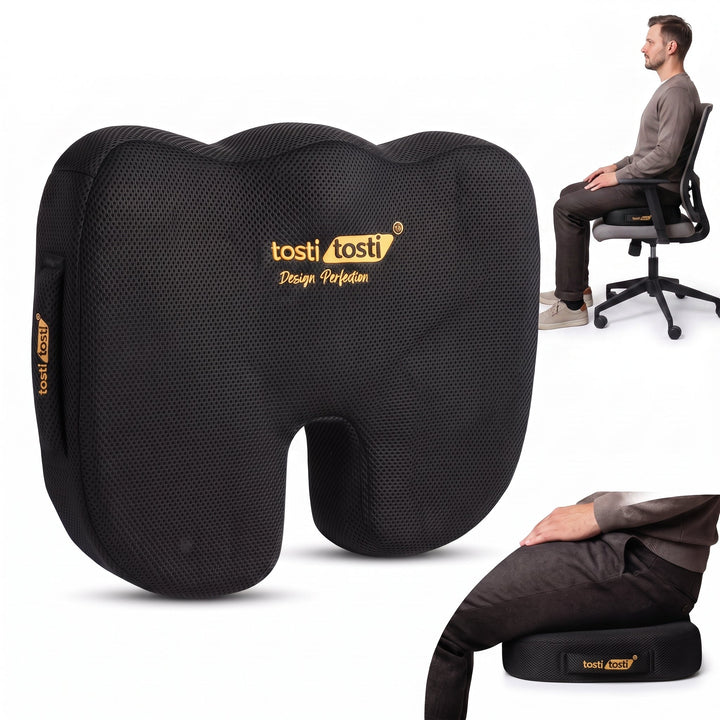
A U-cut cushion has an opening at the rear rather than a complete hole in the middle. The aim is to leave space beneath the coccyx while supporting the thighs and sitting bones on the foam. Many designs also use a gentle wedge or contour to guide placement.
Clinical references describe U-shaped or rear cut-out cushions as a way to let the coccyx sit over an open area. Several NHS physiotherapy leaflets specifically mention U-shaped coccyx cushions, while broader NHS guidance simply recommends a purpose-designed coccyx cushion.
Donut cushion vs U-cut cushion: quick comparison
| Feature | Donut cushion | U-cut coccyx cushion |
|---|---|---|
| Opening | Closed ring around a centre hole | Open channel at the rear |
| Intended loading | Redistributes weight around the ring | Supports thighs and sitting bones while leaving rear space |
| Placement | Can be less obvious which way to orient it | Rear cut-out makes orientation clearer |
| Chair fit | Round shape may not match every chair | Usually follows a rectangular chair seat more closely |
| Best choice? | The one that avoids pressure on the sensitive area and supports a stable, comfortable posture | |
Is one shape proven to be better?
The evidence is limited, so strong claims are not justified. A small retrospective review recorded the preferences of 55 people with coccydynia who had tried both designs. More preferred a wedge-style rear cut-out than a donut, but many preferred neither. That study measured preference, not a cure, and it was not a large randomised trial.
The most sensible conclusion is that a rear cut-out has a clear mechanical rationale for coccyx off-loading and is recommended in several clinical resources, but individual comfort still varies.
How to position a U-cut cushion
- Place the cut-out at the back of the chair, beneath the coccyx—not at the front.
- Sit fully enough onto the cushion that your thighs and sitting bones feel supported.
- Keep both feet supported. Adjust the chair or add a footrest if the cushion makes the seat too high.
- Use the chair back or a suitable support so you are not hovering forwards.
- Check that the cushion is stable and does not slide.
A contoured seat cushion with a rear coccyx cut-out can be used on many office chairs, dining chairs and some car seats. In a vehicle, always confirm that your seat-belt position, head restraint, pedals and visibility remain safe.
What firmness should you choose?
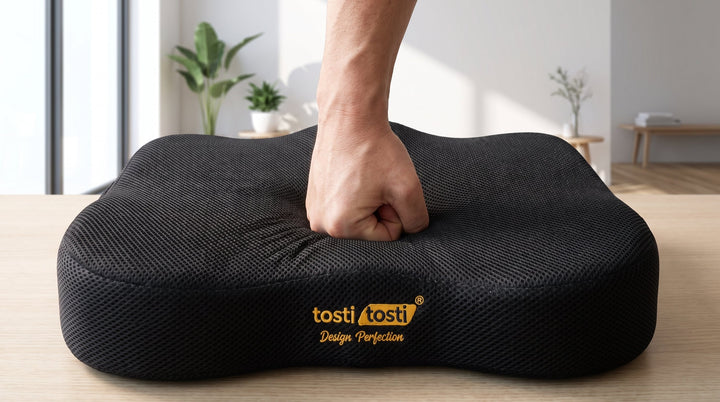
Too-soft foam can compress until the body meets the hard chair underneath. Extremely firm foam may feel uncomfortable at the thighs or sitting bones. Look for support that compresses gradually, keeps the cut-out open and lets you sit evenly without tipping to one side.
Memory foam responds to body heat and load, so give it a few minutes before deciding whether the height and contour suit you.
A cushion is only one part of the setup
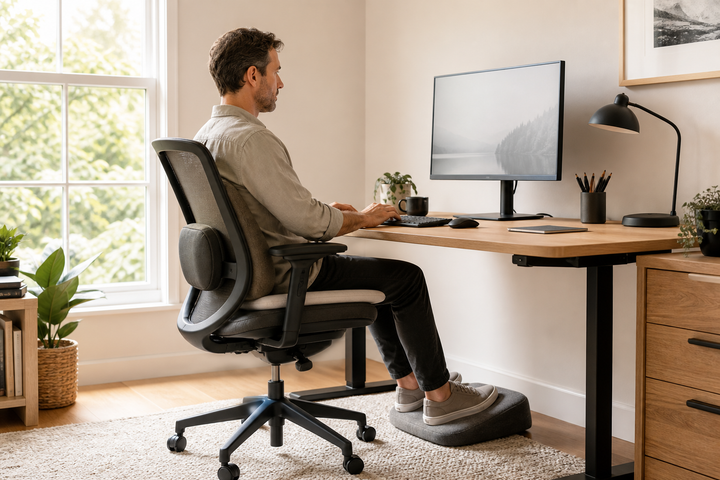
A coccyx cushion should not become permission to sit without moving for hours. NHS guidance advises avoiding prolonged sitting where possible. Change position, take short movement breaks and consider the backrest, screen, keyboard and foot support as part of the same system.
If your lower back also lacks contact with the chair, combine seat support with a correctly positioned back support cushion rather than leaning forwards to escape the backrest.
When should you seek help for tailbone pain?
See a GP or appropriate clinician if the pain has not improved after a few weeks, is affecting normal activities, follows a significant injury, or comes with fever or pain elsewhere. Seek urgent care for new bladder or bowel problems, numbness around the genitals or bottom, rapidly worsening weakness or other serious neurological symptoms.
Frequently asked questions
Which way round does a coccyx cushion go?
For a U-cut design, the opening normally goes at the rear beneath the coccyx. Follow the manufacturer’s instructions because some specialist products differ.
Can I use a coccyx cushion in a car?
Only if it remains stable and does not interfere with safe seat-belt fit, head-restraint position, pedal reach or visibility. Stop using it if your driving position becomes unsafe.
Will a donut cushion fix tailbone pain?
No cushion can diagnose or guarantee treatment. A suitable cushion may reduce pressure and improve sitting comfort while symptoms settle or while you obtain professional advice.
How long should I sit on a coccyx cushion?
There is no universal time limit. Use it as part of a routine that includes regular position changes, and follow advice from your clinician if you have an injury or persistent pain.
Sources and further reading
- NHS: tailbone (coccyx) pain
- University Hospitals of Leicester: managing coccyx pain or injury
- Royal Berkshire NHS Foundation Trust: U-shaped coccyx cushion guidance
- Merck Manual Professional: coccyx disorders and cushion shapes
- Summary of the small retrospective cushion-preference study
Last reviewed: 19 August 2026.