Car Lumbar Support Cushion: Why Thicker Is Not Always Better
Share
By TostiTosti · Sources checked 20 September 2026
Quick answer: A car lumbar support cushion should fill a comfortable gap without pushing you away from the rest of the seat. If it changes pedal reach, belt position, steering-wheel clearance or head-restraint alignment, it is not a suitable fit. Adjust the car's own seat and lumbar controls first, and check the vehicle manufacturer's guidance before adding an accessory.
A car can feel fine on a short test drive and very different during a three-hour motorway journey. The instinct is often to buy the thickest back cushion available. Yet thickness can create a new fitting problem: it moves your body within a seating system designed around controls, restraints and visibility.
This guide is for UK drivers comparing a lumbar cushion for a deep or strongly contoured car seat. It focuses on fit and compatibility rather than promising to treat back pain.
Why a thicker lumbar cushion can feel worse
A back cushion occupies space between your body and the seat. A deep seat may have room for that; a shallow seat or one with prominent built-in lumbar support may not. The same cushion can therefore behave very differently in two vehicles.
Notice whether your shoulders can still settle against the backrest. If only the lower back touches while the rest of you is pushed forwards, adding more support has not created a better overall fit. Similarly, a cushion that feels soft in your hand may occupy substantial space before and after it compresses.
There is no single ideal cushion thickness for every driver. Torso shape, seat contour, built-in adjustments and the foam's response all affect the result. “Memory foam” describes a material; it does not establish vehicle compatibility.
Start with the support already in the car
Use the owner's manual to identify seat-height, fore-and-aft, backrest and lumbar controls. Make adjustments while safely parked. Some cars allow the lumbar area to move vertically as well as in and out, so a pressure point may be a positioning issue rather than a lack of padding.
The Canadian Centre for Occupational Health and Safety's driving ergonomics guidance recommends considering the whole driving position, including back support, controls and visibility. Its fitting principles are useful here; UK road rules and your own vehicle manual remain the relevant local references.
A useful comparison is the same seat with no extra cushion, correctly adjusted. If you cannot establish a comfortable or secure driving position with the original seat, ask the manufacturer or an appropriate professional for advice before trying to compensate with multiple accessories.
The parked-car fit check
First confirm whether your vehicle permits the proposed accessory and strap position. Do not cover seat-mounted airbag areas, interfere with a belt or buckle, or obstruct a seat mechanism. For example, Volvo's V40 side-airbag guidance identifies the space beside the seat as part of the deployment area. That is a model-specific example, not approval for an accessory in another car.
Once compatibility is established, reassess the following with the car stationary. Passing these observations does not certify an accessory's crash safety.
| Check | What would make you stop using the cushion? |
|---|---|
| Pedals and controls | You need to stretch, shift your body or compromise normal control operation. |
| Backrest and head restraint | The cushion separates you from useful backrest support or prevents the head restraint being adjusted as instructed. |
| Seat belt | The belt no longer lies in the position specified by the vehicle manufacturer, or an accessory obstructs the buckle. |
| Steering wheel and visibility | You lose the specified clearance or a clear view of the road, mirrors or instruments. |
| Accessory stability | It slips, bunches or needs repeated repositioning. |
| Comfort | You develop new discomfort, numbness or an intrusive pressure point. |
The Highway Code's vehicle safety guidance says to adjust the seat, belt, head restraint and mirrors correctly before driving. Adding a cushion is a reason to repeat those checks. Do not adjust or retrieve a cushion while the vehicle is moving.
What to compare before buying a car back-support cushion
Footprint: Compare the cushion with the usable central area of the backrest. Deep side bolsters can make the available area much smaller than the seat's overall width.
Profile: Look at the side view as well as the front photograph. A broad contour, small roll and thick pillow take up different amounts of space. Do not treat the maximum listed thickness as a prediction of compressed thickness.
Attachment: Check exactly where any strap travels. A secure-feeling strap is not proof that it is suitable around a seat containing airbags or other safety equipment. Ask the vehicle manufacturer if the manual does not resolve that question.
Care and trial terms: A removable cover may make routine cleaning easier. Read the care label and current returns policy before purchase, especially when the shape needs assessing in your own seat.
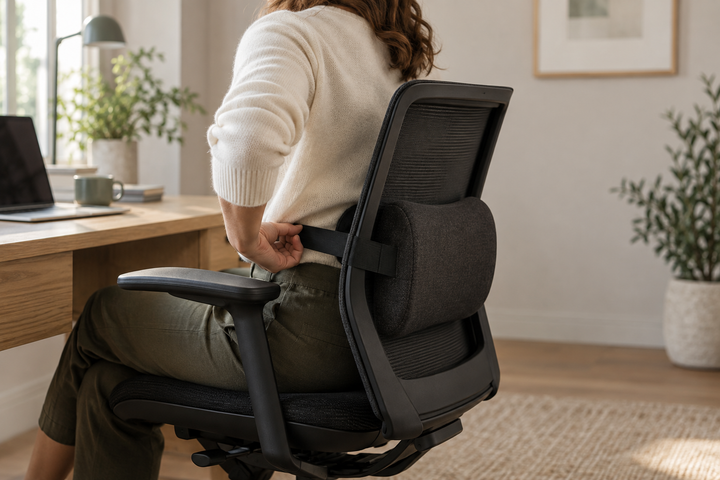
The TostiTosti Back Support Cushion has published approximate dimensions of 50.8 × 40.6 × 10.2 cm, a contoured memory-foam body, removable cover and adjustable strap. Its size may be unsuitable for a narrow or already heavily contoured seat. Those specifications do not establish compatibility with any particular vehicle or its safety systems.
If you also use a cushion at a desk, do not assume the same position will work in the car. For the general placement principles, see our lumbar support pillow positioning guide.
Comfort does not replace a journey break
Plan stops even when the seat feels comfortable. Highway Code Rule 91 recommends a break of at least 15 minutes after every two hours of driving. Stop sooner at a suitable place if you feel tired or uncomfortable. Professional drivers may have additional rules to follow.
Persistent pain needs its own attention. The NHS back-pain guidance explains when to seek help, including pain that disrupts daily activities or does not improve. New numbness or weakness should not be treated as a reason to buy a thicker cushion.
Car lumbar cushion questions
Is a lumbar cushion the same as a car seat cushion?
No. A lumbar cushion sits against the backrest. A seat cushion sits underneath you and changes your height as well as the sitting surface. Both can affect the overall driving position.
Can I put a lumbar cushion over built-in lumbar support?
It may create too much projection. Try the built-in adjustment first and check accessory compatibility. The objective is a workable whole-seat fit, not the greatest amount of padding.
Is any memory foam cushion safe in any car?
No universal assurance can be made from the material alone. Vehicle instructions, restraint systems, fit and secure placement all matter. If compatibility is uncertain, do not use it while driving.
Should I use both a seat and a back cushion?
Only if the combination is compatible and preserves your driving position. Each changes a different part of the setup. Our seat-versus-back cushion comparison explains the distinction.
About this guide: Created for TostiTosti with AI assistance using the linked road-safety, ergonomics and NHS sources. TostiTosti sells the product linked here. This is general information, not medical advice, vehicle-specific approval or a crash-safety assessment. No clinical review or original driving trial is claimed. The hero image is an AI-generated editorial illustration and does not show a tested cushion installation.