Lumbar Support Pillow Position: How High Should It Sit?
Share
Quick answer: A lumbar support pillow should usually sit in the inward curve of your lower back, above the belt line rather than directly under the tailbone. It should feel supportive without forcing your ribs forward or pushing you to the front edge of the chair.
Online ergonomics discussions repeatedly show the same problem: people buy a lumbar cushion, attach it at the default strap height and assume discomfort means the product is wrong. In reality, a few centimetres of adjustment can change how the whole chair feels.
Where is the lumbar curve?
The lumbar area is the lower section of the spine between the pelvis and the ribcage. When seated, place your hand behind your lower back and find the natural inward curve. That is the starting zone for support—not a fixed point that is identical for everyone.
How to position a lumbar pillow step by step
- Sit fully back in the chair with both feet supported.
- Relax your shoulders and keep your pelvis level.
- Place the thickest part of the support into your natural lower-back curve.
- Move it slightly up or down until it fills the gap without creating pressure.
- Secure the strap and retest after 15 minutes.
Signs the support is too low
- It presses into the top of the pelvis or tailbone.
- You still collapse through the waist.
- The support feels like a wedge under you rather than behind you.
Signs the support is too high
- Your ribs or mid-back are pushed forward.
- You arch excessively or cannot relax against the backrest.
- Your shoulders move away from the chair.
Why seat depth matters
A lumbar pillow takes up some of the chair's seat depth. After adding it, you should still have a small gap between the front edge of the seat and the backs of your knees. If you are pushed too far forward, try a slimmer support, adjust the chair seat pan if possible or reconsider whether the chair is the right size.
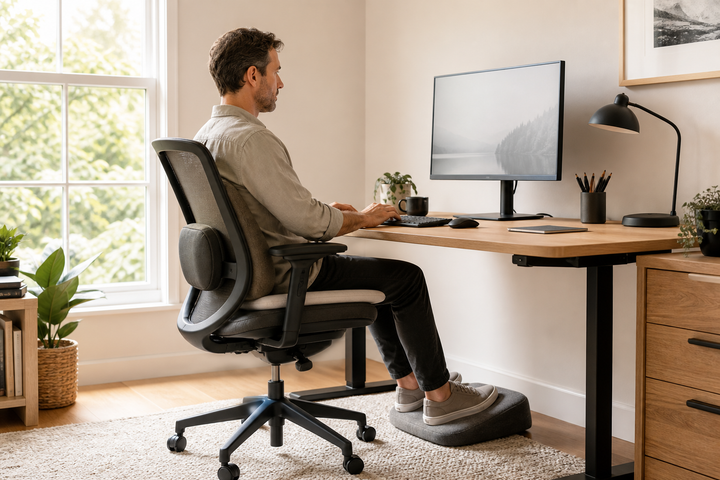
Shorter users often benefit from a footrest because unsupported feet can pull the body forward. Taller users should check that the pillow does not remove too much thigh support.
Can a seat cushion and lumbar support be used together?
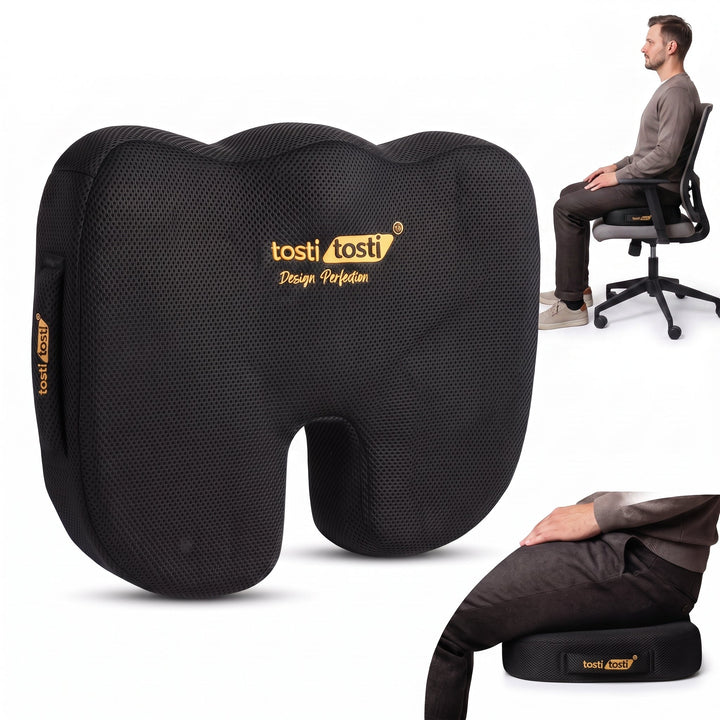
Yes, but set up the seat cushion first because it changes your height. Then adjust desk height, foot support and the lumbar pillow. Our guide to seat cushions versus lumbar support explains what each product is designed to do.
The TostiTosti back support cushion is designed to be repositioned so you can match it to your chair and body. Aim for gentle contact and stability rather than forcing a rigid "perfect" posture.
Frequently asked questions
Should lumbar support feel hard?
It should feel present but not sharp or aggressive. Strong pressure, numbness or increasing discomfort means the position, thickness or chair fit needs reassessment.
Can a lumbar pillow fix back pain?
A pillow may improve comfort and chair fit, but it cannot diagnose or treat the causes of back pain. Seek professional advice for severe, persistent or worsening symptoms.
How often should I adjust the pillow?
Recheck it whenever you change chairs, add a seat cushion or alter desk height. Small position changes during the day are normal.
The takeaway
Position the cushion where it fills your natural lower-back curve, then confirm that your feet, knees, pelvis and shoulders remain relaxed. Good support should help you settle into the chair, not fight against it.
For a fuller explanation of cushion shapes, activated-charcoal memory foam, positioning and the limits of the evidence, read Back Support Cushions: Design, Materials and Evidence.